Wavinaires

Les wavinaires – Questions ouvertes de la SFO en collaboration avec le GDR Complexe et le GDR Ondes

Cette série de webinaires est destinée à un public jeune, étudiants, postdoctorants et jeunes ingénieurs ou chercheursChaque Wavinaire est organisé autour d'une publication connue à l’avance par l’audience, qui permettra d’introduire une thématique transverse à diverses disciplines et applications des ondesLes Wavinaires durent 01h30 et ont lieu en distanciel trois fois par an.

Si la publication est récente, elle portera sur un sujet prometteur à fort impact. Le Wavinaire s’apparentera alors à un exercice de veille technologique avec une analyse poussée. La publication peux aussi se rapporter à une question ouverte, importante et bien que récurrente, non complètement comprise. Le webinaire fera alors la synthèse de quelques travaux phare, des difficultés rencontrées et sur ce qui a été vraiment élucidé.

Déroulé typique d’un Wavinaire :

  • Mini-cours introductif d’une quinzaine de minutes, donné par un étudiant, sur une notion de base nécessaire à la compréhension de l’article.
  • Brève présentation des principaux résultats de l’article soulignant les points discutables, suivie par une mise en perspective critique réalisée par un ou deux experts qui commenteront les retombées industrielles ou académiques.
  • Questions et discussion libre
  • Durant le Wavinaire, tous les participants peuvent commenter ou poser des questions à travers le chat. 

Participez nombreux et faites-nous des suggestions de sujets.

Three wavinars on neural networks is focused on the role of optics and photonics in neural networks

  • Wavinaire n°7: Can AI Help Scientific Discovery in Nanophotonics February 6, 2026 (Third in the series)
  • Wavinaire n°6: Role of optics in neural networks : October 23, 2025 (Second in the series)
  • Wavinaire n°5: Neural Algorithms : Past, Present,Future : May 22, 2025 (First in the series)

Wavinaire 7 : Can AI Help Scientific Discovery in Nanophotonics?

Friday, February 6, 2026 at 3:00 PM

Can AI Help Scientific Discovery in Nanophotonics?

The third in the series of the three wavinars on neural networks is focused on the role of optics and photonics in neural networks.

Marin Soljačić talk will not be recorded

The link to access the live webinar

The expected total duration is a little bit more than 1 hour.

This seventh webinar featured two presentations:

  • 15-minute analysis, delivered by Louis Forestier (Laboratoire Photonique Numérique et Nanosciences, LP2N - Bordeaux), based on the state-of-the-art article “A Multi-Agent Framework for Real-Time, Autonomous Freeform Metasurface Design”, who will explore the true potential of neural networks for "intelligent" optical design, beyond their undeniable ease of programming. This 15-minute analysis will be followed by a brief Q&A session.
  • A presentation by Marin Soljačić (Massachusetts Institute of Technology - MIT) who will share his insights on how photonics can accelerate and diversify AI hardware, and conversely, how machine learning is driving progress in photonics.

With an in-depth press review of the article
 

Article to dowload

A Multi-Agent Framework for Real-Time, Autonomous Freeform Metasurface Design

Robert Lupoiu, Yixuan Shao, Tianxiang Dai, Chenkai Mao, Kofi Edée & Jonathan A. Fan 

Article to download

Wavinaire 6 : Role of optics in neural networks

Thursday, October 23, 2025 from 10:00 AM to 12:00 PM

Wavinaire 6 : Role of optics in neural networks

The second in the series of the three wavinars on neural networks is focused on the role of optics and photonics in neural networks

The conference recording is accessible (Conference Chair : Yannick DUMEIGE)

This sixth webinar featured three presentations :

  • A short 15-minute introductory mini-lecture, delivered by Muhammad-Waqar IQBAL (CentraleSupélec – Université Paris-Saclay) of a key paper in the field of photonics for reservoir computing: Parallel photonic information processing at gigabyte per second data rates using transient states, published in 2013 by published by D. Brunner, M.C. Soriano, C.R. Mirasso & I. Fischer
  • A critical contextualization by Daniel BRUNNER (Université Marie et Louis Pasteur – Institut FEMTO-ST) with Optical neural networks: computing with lasers, with spikes and how to train.
  • An application example presented by Fabrice RAINERI (Université Côte-d’Azur & NcodiN)  will present Photonics for artificial intelligence: What's going on in the industry

With an in-depth press review of the article


Article to dowload

Parallel photonic information processing at gigabyte per second data rates using transient states

D. Brunner, M.C. Soriano, C.R. Mirasso & I. Fischer 

Article to download

Wavinaire 5 : Neural Algorithms : Past, present, futur
Thursday, May 22, 2025, from 11:00 AM to 12:30 PM

Neural Algorithms : Past, Present,Future

The first in the new series will provide an overview of major developments in neural network algorithms.

The first of three wavinars on neural networks

The webinar is in English

The conference recording is accessible

Wavinaire n°5

This fifth webinar will feature two presentations :


With an in-depth press review of the article


Logo

Learning representations by back-propagating errors

D.E. Rumelhart, G.E. Hinton, et R.J. Williams

Article to download

Wavinaire 4 : La décohérence en mécanique quantique
02 octobre 2024 de 14H00 à 15H30

La décohérence en mécanique quantique 

Ce quatrième wavinaire est en Français

Les vidéos sont disponibles

Speakerwavinaire4Ce quatrième wavinaire comporte trois exposés :

Avec une revue de presse approfondie de l'article


Logo

Observing the Progressive Decoherence of the “Meter” in a Quantum Measurement

M. Brune, E. Hagley, J. Dreyer, X. Maıˆtre, A. Maali, C. Wunderlich, J. M. Raimond, and S. Haroche

Article à télécharger

Wavinaire 3 : Focusing coherent light through opaque strongly scattering media
15 décembre 2022, de 13H30 à 15H00

Ce troisième wavinaire se tiendra en Français

En visio-conférence

Les vidéos sont disponibles

Speaker wavinaire 3

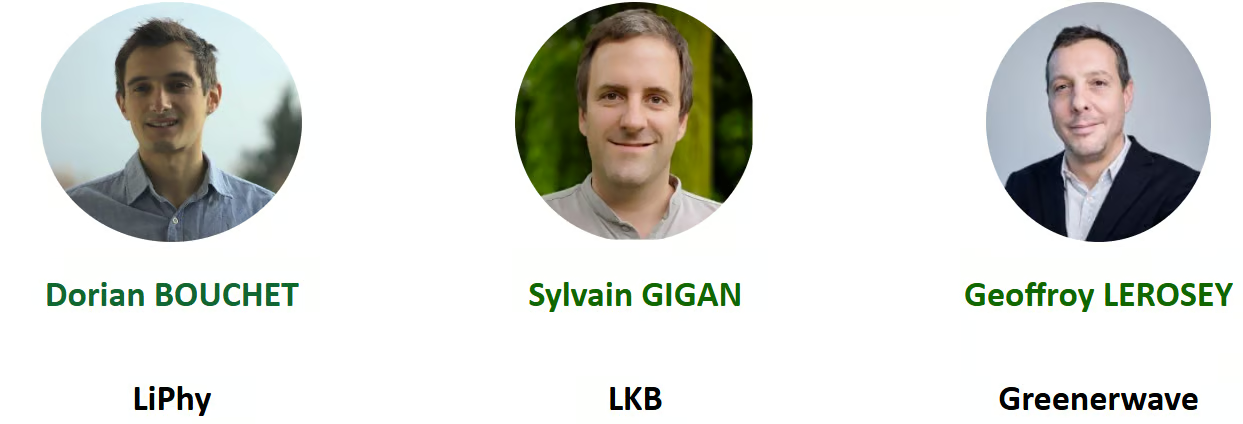
  • une introduction de l'article, du principe de l'optique adaptative et de sa généralisation aux milieux complexes via le concept de matrice de transmission sera donnée par Dorian Bouchet (Post-doctorant au laboratoire Liphy, Grenoble)
  • la généralisation des techniques de contrôles du front d'onde et leurs applications à d'autres observables/contrastes optiques par Sylvain Gigan (Professeur à Sorbonne Université, Laboratoire Kastler Brossel)
  • une ouverture industrielle vers les surfaces intelligentes reconfigurables, pendant du modulateur spatial de lumière pour les radio-fréquences par Geoffroy Lerosey (CEO, GreenerWave)

Revue de presse approfondie

Logo

Focusing coherent light through opaque strongly scattering media

M. Vellekoop* and A. P. Mosk

Article à télécharger

The presentations will analyze the paradigm shift induced by the seminal paper of Vellekoop and Mosk in the field of waves in complex media.

In complex media such as white paint and biological tissue, light encounters nanoscale refractive-index inhomogeneities that cause multiple scattering. Such scattering was usually seen as an impediment to focusing and imaging. However, in a seminal paper inspired by previous studies in the acoustic and microwave domains, Vellekoop and Mosk showed how to exploit scattering and disorder to focus, shape and compress light by controlling the many thousands of spatial degrees of freedom of the incident waves. Wave-front shaping is now routinely performed in the optical realm using spatial light modulators or digital mirror devices while considering different optical contrasts and observables as feedback. This approach has also recently drawn a lot of attention in the radio-frequency community whether it be for wireless communication or imaging purposes due the rapid emergence of reconfigurable intelligent surfaces. 

Wavinaire 2 : Light Propagation with Phase Discontinuities: Generalized Laws of Reflection and Refraction
15 juin 2022, de 15H00 à 16H30

Ce second wavinaire se tiendra en Français, en visio-conférence

Les vidéos sont disponibles

Vidéo - Introduction

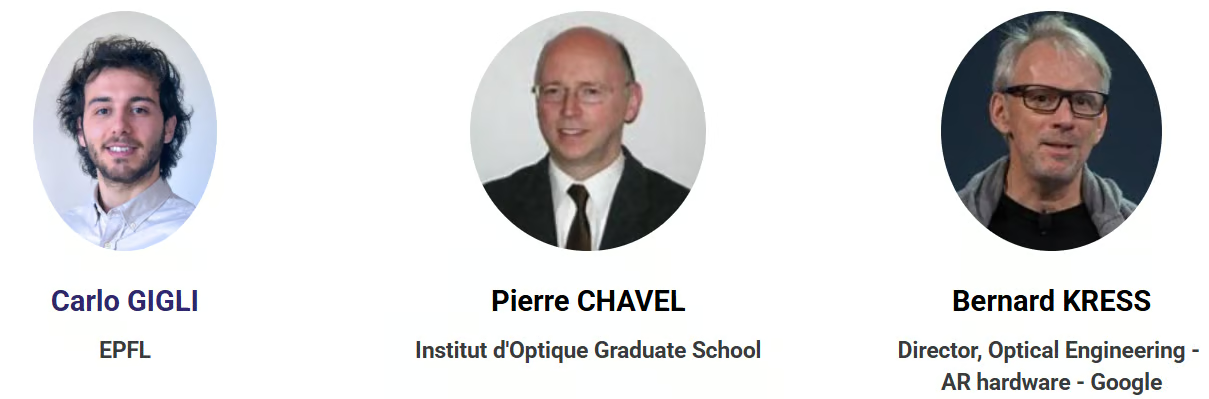
  • Vidéo de l'intervention de Carlo GIGLI
  • Vidéo de l'intervention de Pierre CHAVEL
  • Vidéo de l'intervention de Bernard KRESS

Speaker wavinaire 2

  • une introduction de l'article et du principe de contrôle de la phase par des résonateurs avec Carlo Gigli
  • une mise en perspective de l'article et un rappel historique sur les différentes méthodes pour coder la phase avec des métasurfaces optiques par Pierre Chavel (Institut d'Optique Graduate School, ancien directeur de recherche au CNRS, Laboratoire Hubert Curien, CNRS/Université Jean-Monnet de St-Etienne, IOGS)
  • une ouverture industrielle vers les systèmes optiques compacts pour la réalité augmentée et à la réalité virtuelle par Bernard Kress (Director, Optical Engineering - AR hardware, Google)

Revue de presse approfondie

Logo

Light Propagation with Phase
Discontinuities: Generalized Laws of
Reflection and Refraction

Nanfang Yu,1 Patrice Genevet,1,2 Mikhail A. Kats,1 Francesco Aieta,1,3 Jean-Philippe Tetienne,1,4 Federico Capasso,1 * Zeno Gaburro1

Article à télécharger

The presentations will analyze uncompromising and in deep the breakthrough, the hypes and the promises.

Conventional optical components rely on gradual phase shifts accumulated during light propagation to shape light beams. New degrees of freedom are attained by introducing abrupt phase changes over the scale of the wavelength. A two-dimensional array of optical resonators with spatially varying phase response and subwavelength separation can imprint such phase discontinuities on propagating light as it traverses the interface between two media. Anomalous reflection and refraction phenomena are observed in this regime in optically thin arrays of metallic antennas on silicon with a linear phase variation along the interface, which are in excellent agreement with generalized laws derived from Fermat’s principle. Phase discontinuities provide great flexibility in the design of light beams, as illustrated by the generation of optical vortices through use of planar designer metallic interfaces.

Wavinaire 1 : Broadband Nonreciprocal Amplification in Luminal Metamaterials
12 janvier 2022, de 11H00 à 12H30

En visio-conférence

Les vidéos sont disponibles

Speakerwavinaire1

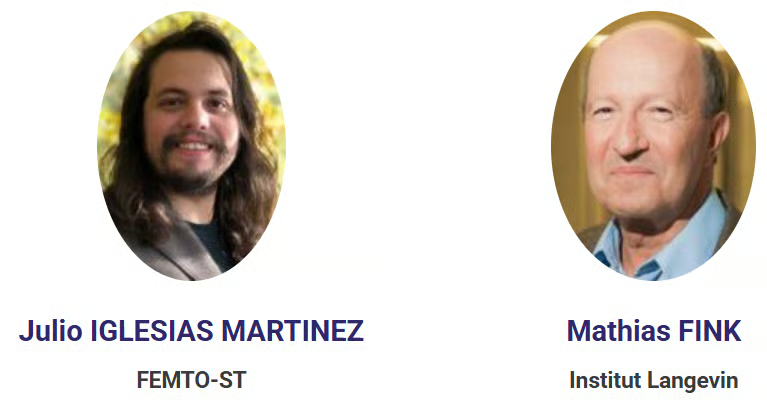
Les concepts d’amplification d’ondes et de milieux non-réciproques dans les matériaux luminiques («luminal materials» en anglais)  trouvent leurs origines dans les recherches effectuées, il y a déjà longtemps, sur l’interaction électron-phonon et sur la technologie des tubes à ondes progressives. Ce sujet a, depuis, été revisité dans le cadre des recherches sur les métamatériaux modulés temporellement. La comparaison de la transmission d’une onde dans un milieu modulé spatialement ou temporellement ou encore mieux spatio-temporellement est très riche d’enseignement. Dans le commentaire de l’article Galiffi, E., P. A. Huidobro, and J. B. Pendry. "Broadband nonreciprocal amplification in luminal metamaterials." Physical Review Letters (2019), je montrerai, à travers plusieurs exemples touchant aussi bien les domaines de l’acoustique, des vagues et des ondes électromagnétiques, que le concept d’amplification paramétrique peut être généralisé en espace- temps et mener à des applications intéressantes. J’évoquerai quelques exemples en biologie qui laissent à penser que la nature a bien compris l’intérêt de ces milieux modulés spatio-temporellement. 

Revue de presse approfondie

Logo

Broadband Nonreciprocal Amplification in Luminal Metamaterials

E. Galiffi, P. A. Huidobro, and J. B. Pendry

Article à télécharger

Le comité de programme

GDR Ondes

Alexandre BARON
Centre de Recherche Paul Pascal

Vincent LAUDE
FEMETO-ST

Eric Lheurette
Universite de Lille

Philippe LALANNE
Laboratoire Photonique, Numérique et Nanosciences, LP2N

Société Français d'Optique

Yannick DUMEIGE
Président du Club COLOQ
Institut Foton- Lannion

François SALIN
Président de la SFO
Président fondateur d'Ilasis Laser - Bordeaux

Ariel LEVENSON
Président sortant de la SFO
C2N - CNRS - Palaiseau

GDR COMPLEXE

Alexandre AUBRY
Institut Langevin